
Google Publishes an Official Guide to Optimizing for AI Search
Key facts
- Published: 15 May 2026, announced on the Google Search Central Blog
- Covers: AI Overviews, AI Mode and other generative AI features in Google Search
- Main message: optimizing for AI search (“AEO” or “GEO”) is still SEO
- Also on 15 May: Google clarified that its spam policies also apply to generative AI responses
Google published a guide on how to optimize pages for the generative AI features in Search – AI Overviews and AI Mode – and announced it on its Search Central Blog.
How AI answers find your page
The guide explains that Google’s AI features ground their answers in pages from the index (retrieval-augmented generation). For a complex question, the system can run several related searches at once (“query fan-out”) and combine the results. That is why the same pages that rank well in classic search are also the ones most likely to be cited.
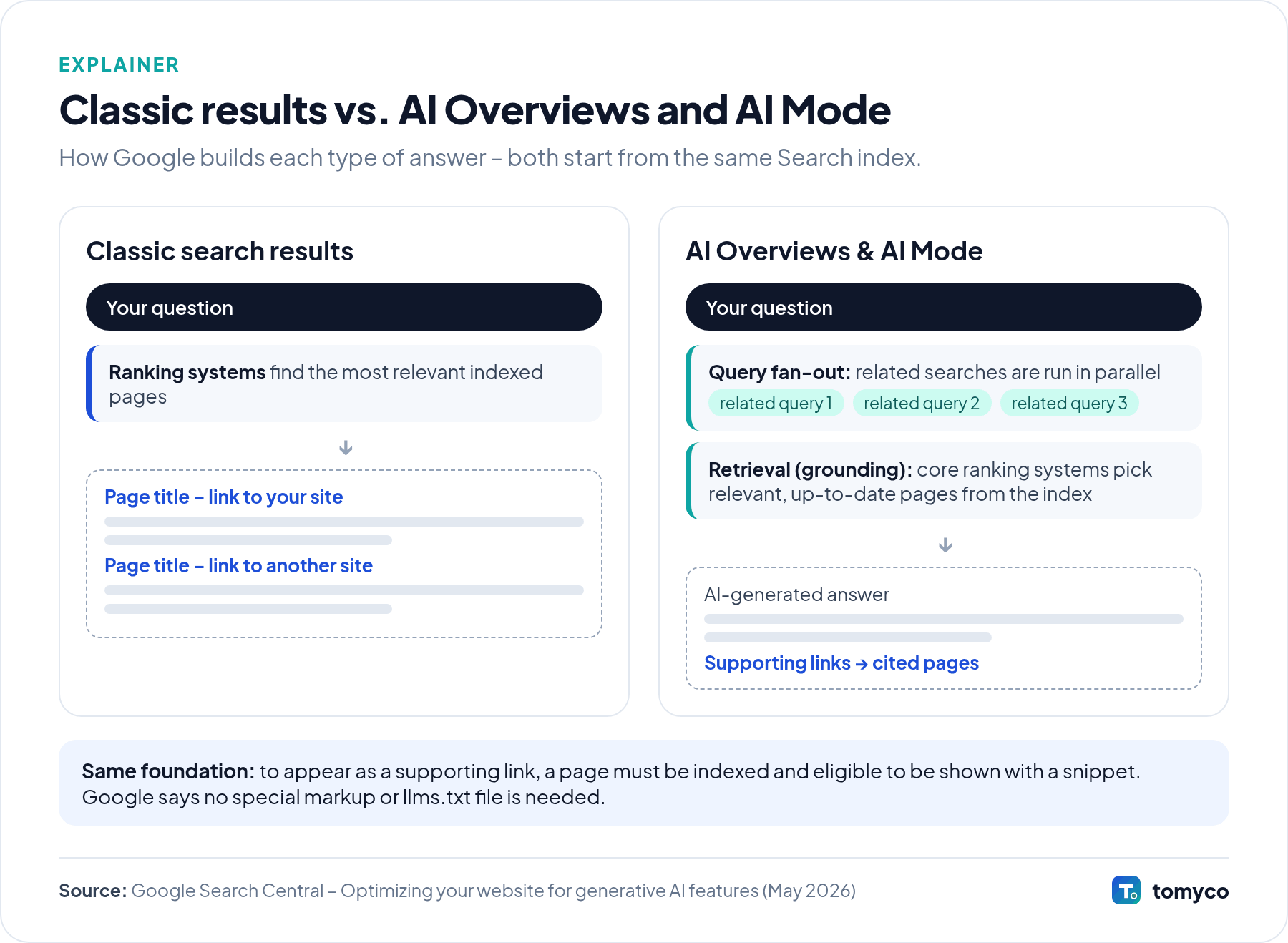
What changed
The key message is that these features rely on the same ranking systems as classic search, so classic SEO remains the foundation. Google emphasizes:
- Non-commodity content – original information and a unique point of view that is not available everywhere else.
- Clear structure – headings and well-organised pages, plus high-quality images and video.
- Technical basics – the page must be crawlable, indexed and eligible for snippets, and the site must not be excluded from Search generative AI features. Semantic HTML is not required; JavaScript sites should follow Google’s JavaScript SEO best practices; page experience and reducing duplicates still matter.
- Merchant Center and Google Business Profile – up-to-date product and business data helps for shopping and local questions.
Myths the guide addresses
Google lists common “AEO/GEO” advice that is not needed for Google Search: special files, splitting content into “chunks” for AI, rewriting pages specifically for AI, creating inauthentic mentions of your brand, and over-focusing on structured data. It also warns against creating a page for every possible fan-out query, which can be scaled content abuse, and against third-party tools that claim to show Google’s internal metrics.
Why it matters for businesses
There is no need to pay for special “AI SEO” tricks or markup. Your budget is better spent on quality content, a technically sound website and a well-maintained Google Business Profile.
What it means in Central and Eastern Europe
In Slovenian, Croatian or Hungarian there is far less high-quality content than in English, so original, local information – local prices, regulations, examples and experience – has a good chance of being used and cited. A complete Google Business Profile in the local language matters for “near me” questions, and multilingual sites should keep each language version indexable with correct hreflang.
Checklist: what to do now
- Check that your key pages are indexed and not blocked from snippets.
- In Search Console, check that the site is not excluded from Search generative AI features.
- Add original information to important pages: your experience, data, photos and examples.
- Structure pages with clear headings and answer the main question early.
- Keep Google Business Profile and Merchant Center data current.
- Skip paid “AI SEO” extras that promise shortcuts.
Video: How AI is changing Google Search and SEO
Update, 15 June 2026: Google added to its documentation that llms.txt files are not needed for Google Search and do not affect rankings.
Official sources
Not sure how a Google update affects your website? Ask us for a review →