
Google and Microsoft Announce a Shared AI Training Control in robots.txt
Key facts
- Announced: 30 October 2026 by Google Search Central and Microsoft Bing
- What: a shared robots.txt signal for AI training preferences across participating providers
- Google: a shared opt-out with no separate Google-Extended rule is planned to be treated like disallowing Google-Extended; support aimed for 2027
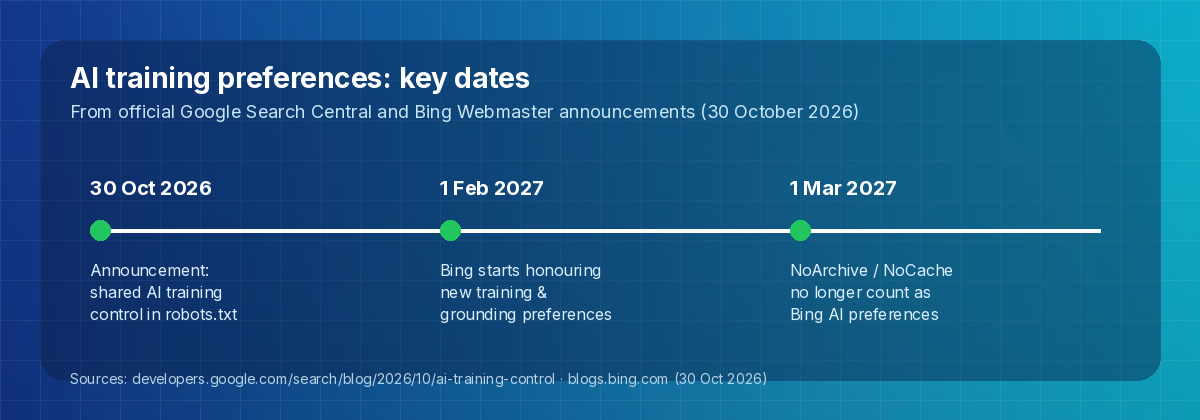
- Bing: separate AI training and AI grounding preferences; NoArchive and NoCache stop counting after 1 March 2027
On 30 October 2026 Google and Microsoft published matching announcements: website owners will be able to express AI training preferences through a shared control in robots.txt, instead of a separate rule for every AI provider. Both posts link the work to the IETF AI Preferences working group and to the EU Code of Practice for general-purpose AI (GPAI) model providers under the EU AI Act.
What changed
Google will support a shared policy token in robots.txt. If a site uses that token to opt out of training and does not set Google-Extended explicitly, Google plans to treat it as if the publisher had disallowed Google-Extended. Company-specific controls such as Google-Extended keep working alongside the joint signal. Google aims to support the new control with other providers in 2027.
Microsoft adopts the shared training preference and adds a separate AI grounding preference. Training means using content to change generative model parameters. Grounding means using content to help inform generated answers in experiences such as Copilot, AI Mode and Microsoft 365. The two choices are independent and neither changes eligibility for traditional Bing search results.
Bing’s new preferences replace NoArchive and NoCache for training and grounding. They begin to take effect as pages are crawled from 1 February 2027. Sites that still rely on those older tags must publish the new settings (and, for grounding, record a temporary preference in Bing Webmaster Tools where applicable) by 1 March 2027. After that date, NoArchive and NoCache will no longer be read as AI preferences.
Why it matters for businesses
A shared signal cuts the need for separate training rules for Google, OpenAI, Anthropic and others, while still allowing a different rule for one provider when needed. Bing’s split between training and grounding is equally practical: blocking training does not automatically remove a brand from AI answers. If citations from Copilot or AI Mode matter, grounding is usually left allowed. Restricting grounding can reduce AI visibility without affecting classic search rankings.
What it means in Central and Eastern Europe
Both announcements tie the shared training preference to the EU GPAI Code of Practice, which treats robots.txt as a primary machine-readable preference for publishers. For companies in Slovenia, Croatia and the wider EU, AI content policy sits next to compliance and brand control, not only SEO. Sites that still use NoArchive or NoCache as a stand-in for AI rules should plan the Bing migration before 1 March 2027.
Checklist: what to do now
- Decide separately whether your content may be used for AI training and whether it may be used for grounding in AI answers.
- Review robots.txt and any Google-Extended, NoArchive or NoCache rules you already have.
- Watch Google’s 2027 rollout of the shared control and keep Google-Extended set if you need a Google-specific choice.
- If you use NoArchive or NoCache for Bing AI preferences, publish the new settings and complete the Bing Webmaster Tools steps before 1 March 2027.
- Document the decision for legal and marketing teams across your EU markets.
Official sources
Not sure how a Google update affects your website? Ask us for a review →