
Google Tightens Its Guidance on AI-Generated Content
Key facts
- When: 1 October 2026 (Google Search Central documentation update)
- What: the guidance on using generative AI content was brought in line with the Search Quality Rater Guidelines
- Who is affected: every website that uses AI for text, images, metadata or product data
- Action: add a human fact-check before anything AI-generated goes live
Google updated its guidance on using generative AI for website content and aligned it with its Search Quality Rater Guidelines. According to Google’s changelog, the aim was to bring the documentation in sync with the presentations Google gives at its developer events.
What changed
Google does not ban AI. The guidance still describes generative AI as useful for researching a topic and for adding structure to original content. What it makes much more explicit is the responsibility of the publisher:
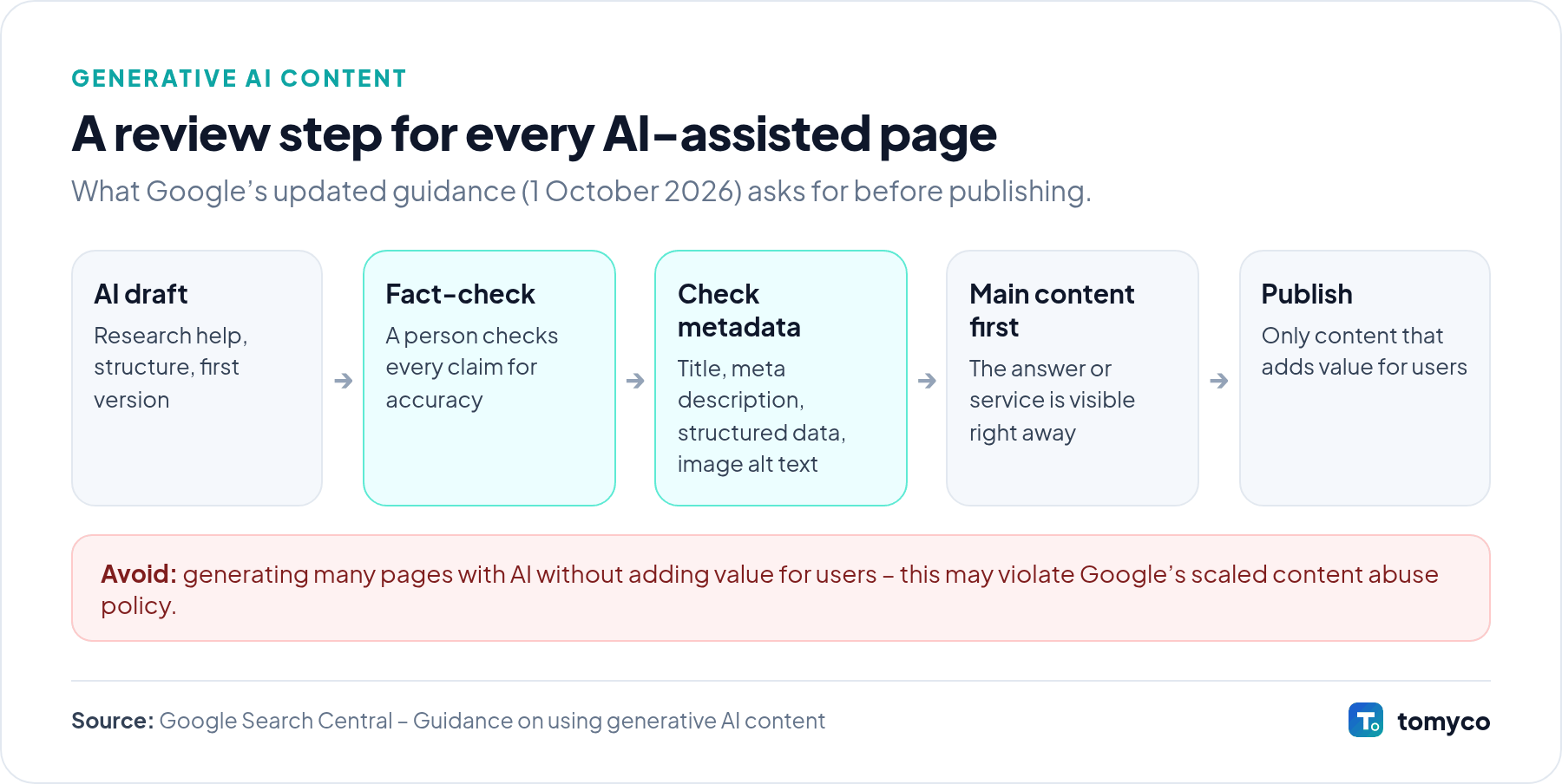
- Human review for accuracy. Language models predict likely words, so their output can contain made-up facts (“hallucinations”). All AI-generated content should be fact-checked by a person before it is published.
- Metadata counts too. The review applies not only to the visible text, but also to title elements, meta descriptions, structured data and image alt text. Structured data should also be validated.
- Scale without value is spam. Generating many pages without adding value for users may violate Google’s scaled content abuse policy.
- Context for users. Google recommends giving readers context about how a piece of content was created where they would reasonably expect it.
- Online shops. For Merchant Center, AI-generated images need the IPTC
DigitalSourceTypemetadata (TrainedAlgorithmicMedia), and AI-generated product data such as titles and descriptions must be labelled as such.
The guidance points to the sections of the Search Quality Rater Guidelines that deal with low-effort and scaled content (sections 4.6.5 and 4.6.6). Google’s page on creating helpful content also describes what raters look for in a page’s main content: the effort behind it, its originality, the talent or skill involved, and its accuracy.
Why it matters for businesses
If you use AI to write product descriptions, blog posts or meta descriptions, a human review step before publishing is no longer optional – it is what Google explicitly expects. The risk is not that a page “looks like AI”, but that it contains wrong facts, repeats what is available everywhere, or exists only to target a keyword.
What it means in Central and Eastern Europe
In smaller languages such as Slovenian, Croatian, Slovak or Hungarian, AI tools tend to make more grammar and terminology mistakes, and they often translate English sources instead of reflecting local facts – prices, laws, place names, local suppliers. Machine-translated pages that are published for many countries at once are exactly the “scale without value” pattern the guidance warns about. A native-speaking reviewer who checks facts and local relevance is the safest way to use AI in these markets.
Checklist: what to do now
- List the pages and product feeds where AI was used, including meta descriptions and alt text generated in bulk.
- Introduce a review step: a person checks facts, names, numbers and claims before publishing.
- Validate structured data with the Rich Results Test after every template or AI-assisted change.
- Merge or improve thin pages that were produced only to cover keyword variations.
- Add something AI cannot: your own experience, photos, data, case studies or expert opinion.
- For online shops, check the Merchant Center requirements for AI-generated images and product data.
- For multilingual sites, have each language version reviewed by a native speaker who knows the local market.
Official sources
Not sure how a Google update affects your website? Ask us for a review →