
Google’s Site Reputation Abuse Policy Now Works Differently in the EEA
Key facts
- Announced: 28 August 2026 on the Google Search Central Blog
- In effect: from 30 August 2026
- Background: discussions with the European Commission under the Digital Markets Act (DMA)
- Where: the change applies to users in the European Economic Area (EEA)
Following discussions with the European Commission under the Digital Markets Act (DMA), Google changed how its site reputation abuse policy applies in the European Economic Area.
What is site reputation abuse?
Google introduced the policy in 2024. It targets sites that publish third-party pages – for example coupon, review or affiliate sections run by someone else – mainly to benefit from the ranking signals of the host site. Hosting third-party content is not a problem in itself: Google looks at how it is presented, its quality, authorship, and whether the same content appears across many sites. Google gives a coupon section as an example where it is unlikely to take action if the content is closely overseen and serves the site’s own audience.
What changed
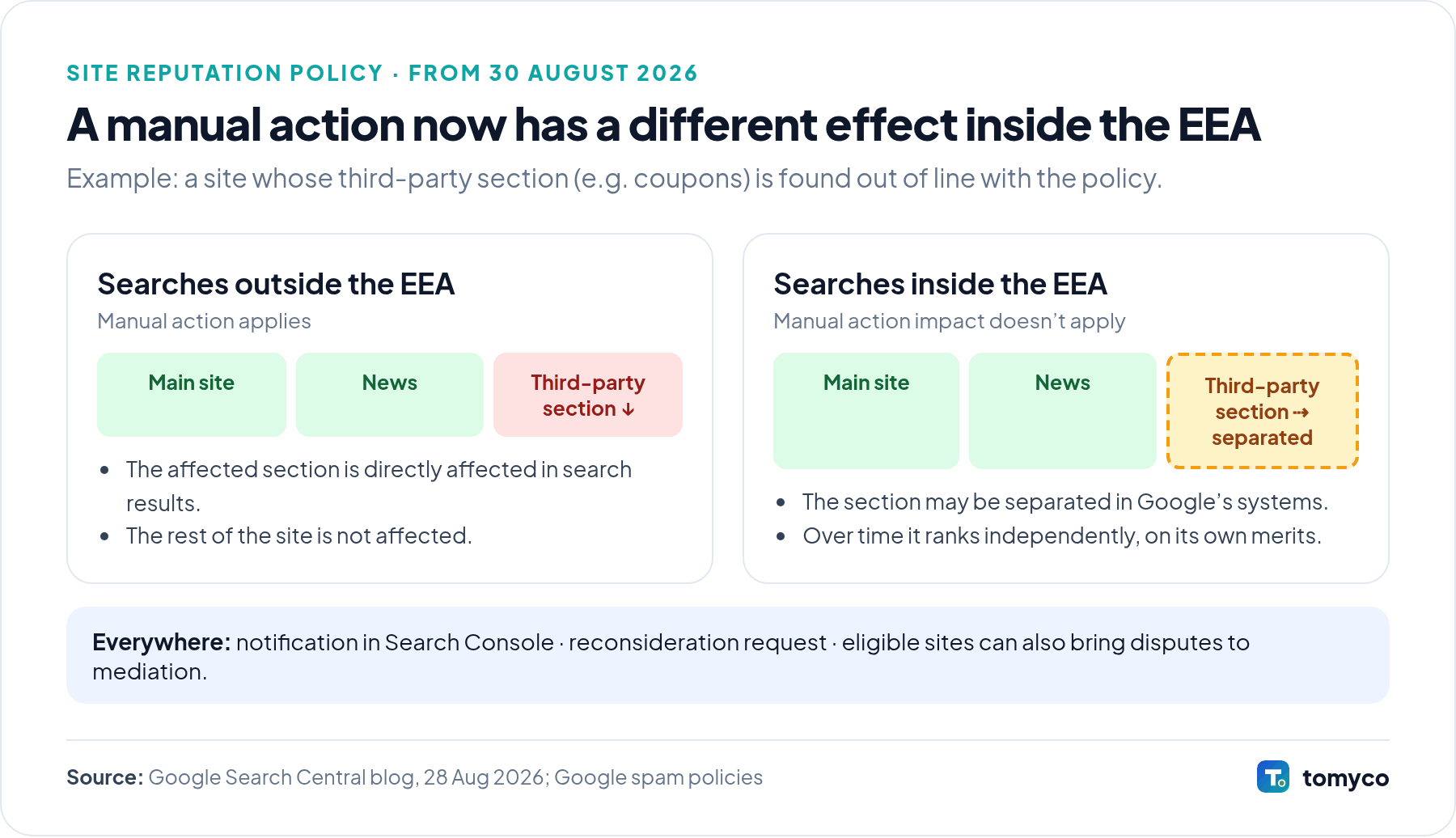
Google no longer enforces manual actions under the site reputation abuse policy for users in the EEA. Outside the EEA, a manual action still affects the section of the site concerned. In the EEA, the impact of such a manual action does not apply; instead Google’s systems may, over time, treat such a section separately so that it ranks independently of the rest of the domain. Previous manual actions under this policy have been lifted for the EEA.
Search Console notifications remain. Google has also described a new reconsideration process for the EEA and an option of alternative dispute resolution (mediation) for eligible sites.
Why it matters for businesses
Media portals, magazines and large sites that host partner content can now see different behaviour in EU and non-EU search results. A section that previously had a manual action may no longer be penalised in the EEA – but it may also stop benefiting from the reputation of the main domain.
What it means in Central and Eastern Europe
Slovenia, Croatia, Czechia, Slovakia, Hungary, Poland and Romania are EU members, so the EEA rules apply to their search results. Serbia, Bosnia and Herzegovina, North Macedonia and other non-EU countries in the region are outside the EEA, where the previous enforcement still applies. For publishers active across the Balkans, rankings for the same section can therefore differ between neighbouring countries.
Checklist: what to do now
- If you host coupons, reviews, partner or sponsored sections, check who produces and oversees that content.
- Make sure third-party content is clearly labelled, edited and relevant to your own audience.
- Check Search Console for notifications about the site reputation abuse policy.
- For sites active in EU and non-EU countries, compare the rankings of such sections by country.
- For sponsored articles, use
rel="sponsored"on paid links.
Official sources
Not sure how a Google update affects your website? Ask us for a review →